Why Are Trading Cards, Custom Keychains and Charm Bars the Photo Experience Behind So Many Brand Activations?
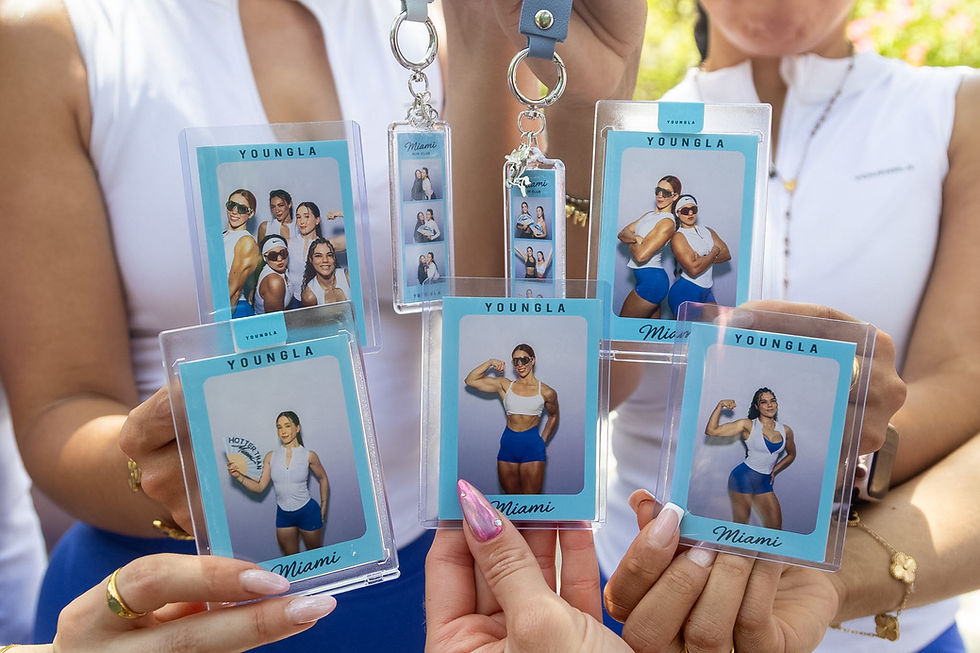
More brands are building trading cards, photo keychains and charm bars into their event activations, and it's not just because the collectibles are fun to look at. Each format gives a guest a different reason to hold onto the branding, and running them together as a collectibles station gets more out of the photo experience than a standard print ever could.
A collectibles station combines all three formats built around a guest's photo, a custom trading card, a double-sided photo keychain, and a charm bar where guests personalize that keychain themselves. Guests step up to the booth and choose how they want to take their photo home.
The card gives a guest something to keep and display. The keychain gives a brand something that leaves the event and stays in daily rotation. The charm bar turns the keychain into an interaction the guest controls instead of something they're just handed. Here's how each piece works, why the format is catching on, and what it takes to run all three at once.
How Does the Trading Card Piece Work?
A guest steps up to the booth and takes their photo the same way they would at any activation. From there, we place that photo into a branded card design, print it on site, and seal it into a protective case before the guest leaves the station.
The card design can carry the event name, sponsor, city, stats, or any other detail tied to the campaign. A sports brand might build it to look like a rookie card. A fashion label or beauty brand might design it closer to an editorial cover. The photo process stays the same, but the finished design changes with who's booking it.

Why Do Trading Cards Work So Well as a Collectible Format?
Trading cards don't need much of an introduction. Topps has made licensed cards for more than seventy years, and Fanatics bought the company in 2022 and folded it into Fanatics Collectibles, building relationships across the NFL, NBA, MLB, Formula 1, MLS, UEFA and WWE.
The hobby side has gotten loud. Fanatics Fest launched in 2024 and drew more than 70,000 fans, then jumped to more than 125,000 across three days in 2025, including a full sellout on Saturday. A single card can now move real money too. In March 2025, a one-of-one Paul Skenes rookie patch card sold at auction for $1.11 million, purchased by Dick's Sporting Goods for display in one of its stores.
Nobody walking away from a brand activation thinks their card is worth a million dollars. What matters is the behavior that makes those numbers possible. People understand limited runs. They compare cards, trade them, protect them, display them. That instinct transfers directly to an event floor. Hand someone a card with their own photo on it, tell them only a certain number exist for that city or that night, and you've built the same pull a $12 pack at Target creates, just personalized.
How Does the Photo Keychain Piece Work?
The keychain uses the same photo, but it's built for a different job than the card. A trading card is something a guest keeps at home, on a desk or in a binder. A keychain goes on the thing they carry every single day, their actual keys, a gym bag, a backpack, a purse strap.
Our photo keychains are double-sided, the guest's photo on the front and the brand on the back, so every time that keychain gets used, the branding goes with it.
That's a very different kind of impression than a logo on a step-and-repeat. It's a logo someone sees while unlocking their front door three months after the event, in a context that has nothing to do with your brand and everything to do with their own life.

How Does the Charm Bar Piece Work?
The charm bar turns the keychain from a takeaway into an interaction. Guests pick charms and build onto their photo keychain themselves, and we can mix generic decorative charms with custom ones built specifically for the client.
A fitness brand might have charms shaped like dumbbells or running shoes next to a charm built from its own logo. A sponsor at a larger event might turn its logo into one of the options sitting on the table. The finish can flex too, clean and minimal for one brand, rhinestones and color for another.
The part that actually matters for brand recall is small but specific. The guest has to choose your logo. They see it sitting among the other options, decide they want it, and physically add it to something they're going to carry. That's a different kind of memory than a logo they just happened to be standing near.
Does This Actually Drive Engagement, or Is It Just a Nice Souvenir?
Both, and that's the point. Guests still want the digital photo they can text to a friend or post that night. But there's a different reaction when you hand someone a physical object with their face on it. People hold their cards up immediately, show them to whoever's next to them in line, and photograph the finished keychain before they even leave the booth area.
That physical object is often the thing that ends up on social media, not the plain digital photo. A generation raised on posting has no problem posting a picture of a physical souvenir. The two formats aren't competing, they're feeding each other. One interaction produces content for the guest's phone and an object for their bag.
Where Does This Work Beyond Sports Events?
Sports and fitness are the obvious fit, but we'd stop short of limiting it there. We've built these activations for retail pop-ups, fashion events, product launches, fan festivals, movie premieres, college events, conferences, trade shows, corporate events, sponsor activations and multi-city tours.
The format flexes to the audience. A beauty brand doesn't need a rookie-card layout, its collectible reads more like an editorial cover. A film premiere can build cards around characters or key art. A tour sponsor can create charms that only exist at that one stop. The question we start with on every project is simple. What would this specific guest actually want to keep? Everything else gets designed around the answer.
What Happened When We Built This for YoungLA's Run Club?
YoungLA runs its Run Club series in cities across the country, and we built a custom trading card, photo keychain and charm bar activation around it, tailored to each stop so a Miami guest and a Chicago guest weren't walking away with identical souvenirs.
We planned for a limited run of the first 50 guests. We ended up producing for around 300.
The line kept growing past the original cap, so we expanded production on site rather than cut people off. Some of the other activations at the same event had already started wrapping up while our line was still moving. And the thing that stood out most wasn't the volume, it was that guests kept asking for both products instead of picking one. They wanted the card for home and the keychain for their bag, two different reasons to keep the same brand around.
We also built a branded pickup station so the experience stayed consistent from the booth all the way to the finished collectible, instead of guests walking away from a custom kiosk and finishing the process at a generic folding table.
What Should You Ask a Vendor Before Booking a Trading Card or Keychain Activation?
This is the part that separates a fun idea from an operation that actually holds up under a real line. Making 25 personalized keychains in a quiet studio is nothing like producing hundreds while a queue is forming in real time.
Ask how many guests a vendor expects to process per hour and how they staff for that number. Ask what happens when turnout runs past projections, the way ours did at 300 instead of 50. Ask who's managing the line and the pickup process, and ask to see mockups before the event so you know exactly what's being branded, the kiosk, the card or keychain design, the charms, the signage and the pickup station itself. For anything beyond a small guest count, ask about backup equipment and supplies too. A guest in line doesn't care why a printer went down. They only notice that the line stopped moving.
Why Book This Through Esteem Photo Booth Rentals?
We run the collectibles station as a turnkey service from planning through breakdown, branding, equipment, staffing, on-site production, assembly, guest flow and pickup included. When volume shifts mid-event, the way it did going from 50 planned guests to roughly 300 actual ones at YoungLA's Run Club, our team adjusts without the client having to pull their own staff onto assembly duty.
Whether you want all three formats running together or just one piece of it, Esteem Photo Booth Rentals builds the collectibles station around what you need guests to walk away with. We produce it for single events and multi-city campaigns that need to stay consistent from one market to the next.
Explore our Custom Trading Card Photo Booth Explore our Custom Photo Keychain & Charm Bar View More Brand Activations from Esteem Photo Booth Rentals
Tell us what you want your guests to walk away with, and we'll build the collectible around it


Comments