AI Photo Booth vs AI Sketch Bot for Corporate Events: Which One Should You Book?
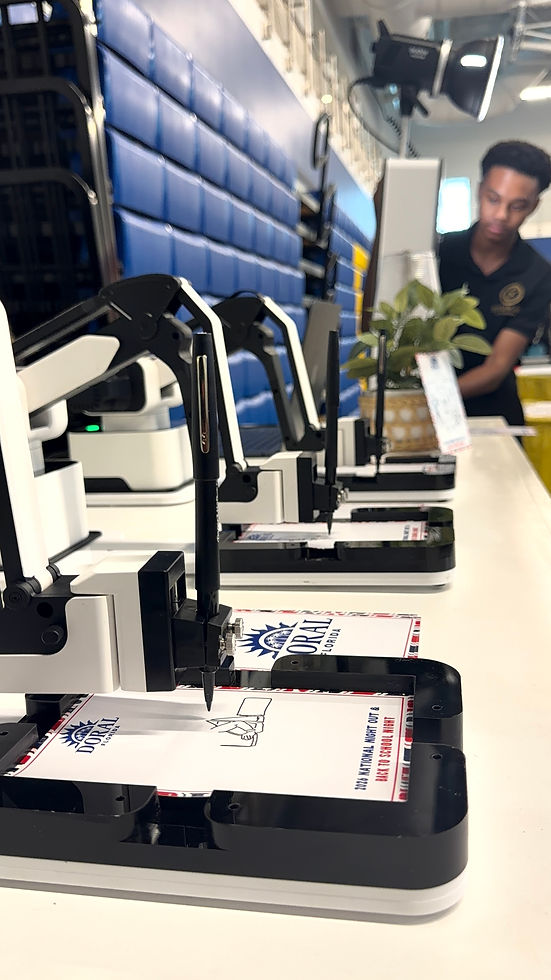
An AI photo booth generates a fully rendered photo of the guest in 10 to 30 seconds, placing them in a custom scene, outfit, or brand concept. An AI Sketch Bot uses a robotic arm to draw a custom portrait of the guest onto paper, which takes longer per guest than an automated render. One is fast and built for volume. The other is slower per unit and built for a physical keepsake guests watch get made in front of them. Esteem 360 Studios runs both formats with professional-grade hardware and trained on-site attendants, and picking between them comes down to your guest count, your time window, and what you want people walking away with.
Which One Should You Book for Your Event?
Book the AI photo booth if you're running a short, high-traffic event, a trade show floor, a stadium concourse, a brand launch with a hard end time. Book the AI Sketch Bot if guests have time to linger, a gala, a VIP lounge, a multi-day conference booth where dwell time actually helps a sponsor instead of hurting one.
The decision usually comes down to two questions:
How many guests need to move through in how many hours?
Do you want a branded photo moment, or a keepsake guests spend time creating?
How Do the Costs Compare?
The AI Sketch Bot typically costs more per guest hour than a standard AI photo booth setup, mostly because of staffing. A Sketch Bot needs an attendant walking guests through the drawing step, and that step takes longer than a photo booth's automated generation, so fewer guests move through per hour on the same rental block. An AI photo booth's cost is driven more by concept complexity, how many custom scenes get built, whether you want branded overlays, and whether guests receive a print in addition to a digital file.
Neither format has a fixed number that applies across every event. Guest count, hours booked, staffing, and whether you're adding prints all move the quote. Esteem builds pricing around what an event actually needs rather than a flat day rate, so the fastest way to get real numbers is to send over your guest count and time window directly.
What Do the Two Formats Have in Common?
Both run on professional-grade hardware with trained on-site attendants, not a homemade rig someone's running for the first time
Both run on custom concepts built around your brand, campaign, or event theme, not a generic filter pulled off a shelf
Both deliver a shareable digital file by text, email, or QR code
Both work as standalone activations or as one station inside a larger multi-format setup
Both collect guest data at the point of interaction when a lead capture step is built in
Both photograph well for social content, since the novelty of "an AI made this" gets people posting on their own
How Do the Two Formats Actually Differ?
AI Photo Booth | AI Sketch Bot | |
Output | Fully rendered photo in a custom scene or outfit | Robotic arm drawn portrait on physical paper stock |
Generation time | 10 to 30 seconds per guest | Roughly 30 seconds to a minute per piece, in line with the broader robotic-arm market |
Guest interaction | Pose and pick a concept | Answer a quick prompt, then watch the arm draw the portrait |
Best guest volume | High, built for lines | Lower per arm, scales by adding more arms |
Physical takeaway | Optional print add-on | Usually the point of the experience |
How Does the AI Sketch Bot Get Customized for Each Event?
The AI Sketch Bot doesn't run one static drawing style for every guest. Esteem builds prompts directly into the experience, so guests answer a question or two before the artwork generates, and the output reflects their answer instead of a generic template.
At a large back-to-school student event, guests were prompted to pick their dream career, and that answer shaped a custom piece of art for each participant. A future doctor, a future athlete, and a future engineer all walked away with different artwork built around the same prompt, not the same sketch with a different name on it. That's the difference between a novelty filter and a designed experience, and it's why the prompt gets built around your event's theme before guests ever step up.
Beyond the prompt itself, Esteem customizes four more layers of the experience:
Event logos, custom footers, and brand messaging get built into the physical paper stock, not just tacked on as a sticker after the fact
Guests can get a realistic portrait, an exaggerated caricature, or a fully custom themed scene that places them inside your event's world instead of a plain background
Multiple robotic arms can run in parallel to keep a line moving at a larger guest count, the same logic that drives the scaling numbers below
The drawing itself can stream to a nearby screen, so guests waiting in line watch each portrait get built stroke by stroke instead of standing in a queue with nothing to look at
A shareable online gallery link goes out after the event, so guests who never got their piece scanned or texted on-site can still track it down
Esteem runs this same prompt-driven build nationwide, in Vegas, Orlando, Miami, or anywhere else in the United States, with the questions, branding, and artwork style customized to match whatever the event actually needs.
What Use Cases Work Best for Each Format?
The same underlying AI technology shows up in three different setups, and the format you pick changes what the experience feels like on the ground.
AI roaming booth. A staff member carries a tablet or camera through the crowd instead of guests coming to a fixed station. This works for networking receptions and exhibit hall floors where people don't want to leave their conversation to find a booth. It's a natural fit for the AI photo booth, since generation is fast enough to keep pace with someone walking a room.
Digital-only AI booth. No printer, no physical output, just a fast digital delivery to a guest's phone. This is the highest-throughput version of the AI photo booth and the one that clears a line fastest at a short, high-traffic event.
AI booth with prints. Adding a print component slows throughput slightly but gives guests something to carry out of the venue, which matters more at a gala or brand activation than it does on a fast-moving trade show floor. This is also where the AI Sketch Bot naturally lives, since the robotic arm draws straight onto physical paper stock and the print is the entire output, not an add-on.
How Do You Scale Each Option for a Large Event?
Guest count | AI photo booth | AI Sketch Bot |
Under 300 guests | 1 station | 3 robots |
300 to 1,000 guests | 2 stations | 4 robots |
1,000+ guests | 3+ stations, often a shared branded enclosure | 2 stations of 5 robots each |
Esteem's Perry Ellis Guayabera Day activation at loanDepot Park moved more than 2,000 guests through two AI photo booth stations during a single Marlins game. The AdventHealth activation at the Buccaneers NFL Draft Block Party in Tampa scaled to three stations for an 8,000-person crowd. Both prove the same point: AI photo booths scale by adding stations, because each station clears guests fast enough that more stations means proportionally more throughput.
An AI Sketch Bot doesn't scale the same way. It holds close to 3 to 4 robots for anything under 1,000 guests, since the drawing step itself is the bottleneck, not the hardware, so there's a real floor even at smaller events. Cross the 1,000-guest mark and Esteem splits that capacity into two stations of 5 robots each, rather than clustering every unit into one line. If you need to move a few thousand people through in three hours, more AI Sketch Bots isn't the fix. A different format is.
Why Doesn't a Sketch Bot Work for a Short, High-Volume Event?
Because each robotic arm can only draw one guest at a time, and that's still slower per unit than a photo booth's automated generation. A single arm can't clear a line of 500 people in a two-hour window, and matching a photo booth's volume means booking enough arms to run in parallel, which drives up cost and footprint fast for an event that only needs a few hours of throughput. A trade show floor, a stadium concourse before kickoff, a product launch with a hard cutoff, these are AI photo booth territory. The AI Sketch Bot belongs at events where guests already have time on their hands: a multi-day conference lounge, an evening reception, a VIP area where watching an arm draw a personalized portrait is the entertainment, not an obstacle.
Esteem won't recommend an AI Sketch Bot as your only activation for a short, high-attendance event without pricing out the arm count that volume actually requires. It gets positioned as a secondary station or saved for the right event type instead.
What Are Good AI Photo Booth Ideas for an Entertainment-Focused Event?
A character or costume transformation tied to a movie, game, or brand mascot
A retro concept, a Gatsby-era portrait or a throwback album cover style
A sports fantasy scene, which is exactly what Jordan Brand and Dick's Sporting Goods built at Dadeland Mall, placing guests in a Jordan-style dunk pose instead of a stock sports backdrop
A multi-scene choice, the way the Miami Marlins activation let fans pick between batter, pitcher, or base runner, which drove repeat visits from guests who came back for a second photo in a different scene
What Does the Data From an Activation Actually Look Like?
Skip the industry-wide percentages you'll find on other sites and look at what a real activation actually produced instead. At a Tory Burch keychain activation, Esteem's data capture flow ran 950 guest sessions, produced more than 1,500 keychains, and collected 870 phone numbers along with more than 180,000 impressions, all tied to data captured at the point of creation rather than a follow-up form. The ADT smart doorbell activation runs the same model continuously: guests scan a QR code, answer a short survey, and every response feeds ADT's lead pipeline game after game across a full Marlins home season, not just a single event day.
That's the kind of number a brand can actually verify, since it's tied to a named client and a specific activation instead of a percentage pulled off a vendor's own marketing page. The same data capture flow runs underneath both the AI photo booth and the AI Sketch Bot, so whichever format you book, the lead data comes out the same way.
What Are Good AI Concepts for a Corporate Event?
A branded product placement scene that puts the guest inside the campaign instead of just standing next to a logo
A virtual try-on concept for a fashion, retail, or apparel launch, letting guests see themselves in new products or branded uniforms without a fitting room on-site
A lead-capture flow built into the experience itself, the way ADT's smart doorbell activation runs a QR scan and short survey before the photo, feeding every response straight into ADT's pipeline across a full Marlins home season
An executive or team-culture concept for an internal event, placing staff into a shared brand moment instead of a generic step-and-repeat
A corporate photo booth lineup that pairs an AI station with a headshot lounge, covering both the fun moment and the LinkedIn-ready professional shot in one footprint
What Photo Booth Idea Will Actually Blow Guests' Minds?
Pair the two formats instead of picking one. Run the AI photo booth for the fast, high-volume moment, then route guests toward the AI Sketch Bot as a slower, optional add-on where a robotic arm turns that same photo into a hand-drawn portrait guests watch get made in real time. Sealed into one of Esteem's signature acrylic card cases with a sticker-pack reveal, a Sketch Bot output stops being a novelty sketch and becomes a collectible nobody else at the event is handing out.
For an even bigger reveal, print the original AI photo booth image and the Sketch Bot portrait together as a single keepsake, so guests walk away holding both the fast branded photo and the slower hand-drawn piece side by side instead of choosing one over the other.
That's the kind of pairing that only works when one vendor runs both formats and can build the handoff between them instead of coordinating two separate companies on the same show floor. Talk to Esteem about which format, or which combination, fits your guest count and your event window.


Comments